Inside the SHRedmobile: How Crankworx Athletes Can Help Advance Concussion Research
As the big 20th edition of Crankworx Whistler is around the corner – August 8-17 – the SHRedmobile is confirmed to return to the festival. Once again, athletes have the chance to participate in cutting-edge research focused on brain health in mountain biking. We spoke with Matt Neill, MSc., from the University of Calgary’s Sport Injury Prevention Research Centre, to learn more about the SHRedmobile, what athletes can expect when they visit, and how their participation is helping to fill critical knowledge gaps around concussion and head impacts in action sports.
Can you tell us about the SHRedmobile and what its purpose is at Crankworx Whistler this year?
The Shred mobile is a mobile research lab that allows us to expand the reach of our program. We do sport-related concussion research including evaluation of physiological outcomes related to concussion and repetitive head impacts at the Sport Injury Prevention Research Centre (SIPRC) and Cerebrovascular Concussion Lab in the Faculty of Kinesiology at the University of Calgary, but not everyone can come into the University for testing. The SHRed mobile allows us to bring the research to the community and engage communities that are under-represented.
We’re bringing the SHRed mobile to Crankworks to investigate concussion, head impacts, and neurological function in downhill mountain bikers. The head moves a lot when mountain biking, and sometimes crashes happen, It’s part of the sport. As a result, mountain bikers are at risk for concussion and repetitive head impacts. Little is known about concussion rates in mountain biking and how brain physiology and function are impacted in the sport. We’re thrilled to be working with Crankworx again this year.
What can athletes expect when they visit the SHRedmobile?
What kind of cognitive and concussion-related testing are you conducting during your neurological evaluations with athletes, and how long does it take?
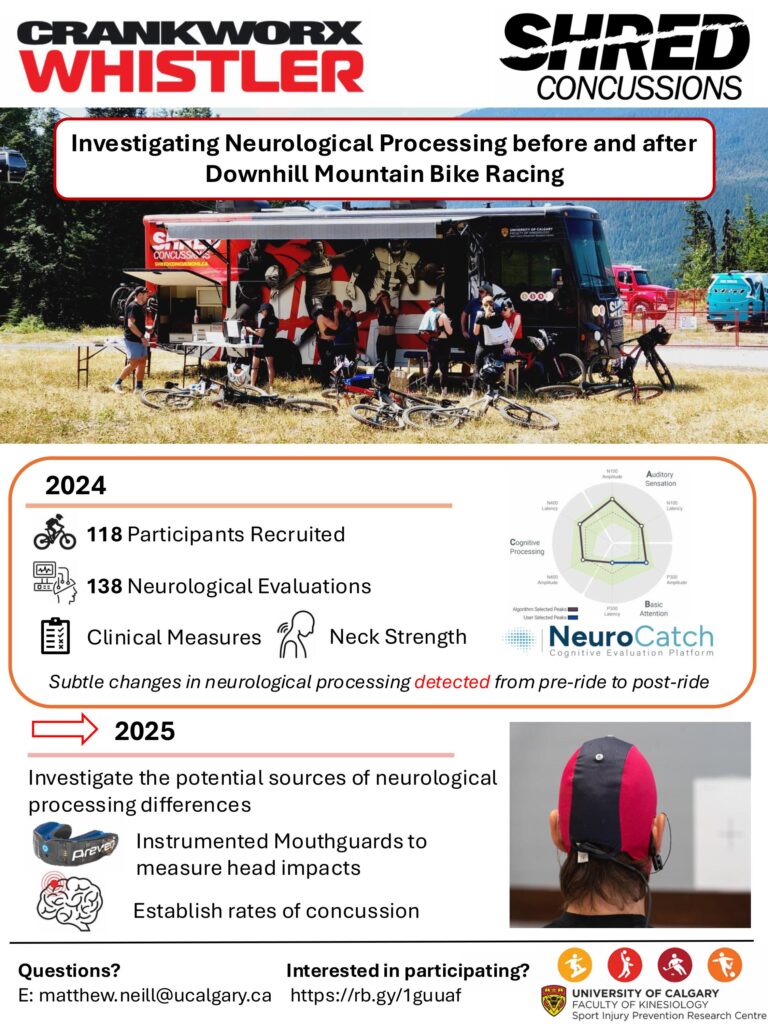
We’re recruiting mountainbikers to participate in the ‘SHRed Concussions’ research study. We’re interested in enrolling mountain bikers aged 14 years and over to study how their brain function changes from pre- to post-ride throughout the event. There are three components to this research project.
- Injury and concussion surveillance will support a greater understanding of injury and concussion rates, mechanisms, and risk factors. Riders will have an opportunity for follow-up following any suspected concussion.
- A benchmark neurological evaluation collected during registration or bib pick up, and follow up evaluations after days of riding. The evaluation takes roughly 15 minutes to complete and provides information about sensory, attentional and cognitive processing performance of the brain.
- For those that are interested, we’re bringing instrumented mouthguards which we will fit with athletes after they complete the first neurological evaluation. These mouthguards track the number and magnitude of the head accelerationevents related to head impacts or linear/rotational head ccelerationsduring each ride. We will use this data to eval uatehead accelerations in mountain bikers during a downhill event whether or not they crash, and whether repetitive head acceleration events affect neurological performance. Fitting of the mouthguards will take 10-15 minutes.
Even if unsure about participating in the study, we encourage anyone interested in concussion to swing by the SHRedmobile to chat, we love to talk about our work!
Why is it important for athletes, especially in action sports like mountain biking, to get involved in studies like this?
Sport-related injury research has traditionally focused on team sports. Action sports, like downhill mountain biking, are growing in popularity, but there has been little injury prevention or sport medicine research in this sport. Participating in this research is a great way to ensure that downhill mountain bikers are represented in sport-related injury, concussion, and head acceleration event research.
What benefits might athletes receive by participating in this study – either immediately or down the line?
Each participants will have access to any injury or concussion evaluation information as well as other outcomes including neurological evaluation. Outcomes from the research may inform improvements in the safety of mountain biking in the future.
For any athletes participating in 2024, will there be any changes to the assessment? Is there a benefit for athletes to return?
We are really excited to engage with the athletes that participated last year. We were able to detect subtle neurological changes from pre- to post- ride in the athletes that participated. We’re interested to see if these changes are detectable now, a year later, in the same participants. We’re using the instrumented mouthguards this year to evaluate head acceleration event during the events, which we hope will provide a new, exciting reason to participate again this year.
Can you share any preliminary insights or findings from last year’s data collection at Crankworx?
We found that for the most part, neurological function remained unchanged from pre- to post- mountainbike ride in those that were not injured. We did detect some neural processing differences from pre- to post- ride consistent with other research in collision team sports such as ice hockey. We were also able to detect baseline neurological differences between males and females that may inform the use of neurological testing in sport.
Are there any common misconceptions about cognitive testing or brain injury research you’d like to address?
Research in concussion has made a lot of recent progress, but there are still some misconceptions out there. There are some fantastic resources for athletes, parents or coaches to stay up to date through Parachute: https://parachute.ca/en/injury-topic/concussion
For athletes on the fence, what would you say is the biggest reason to stop by the SHRedmobile during the festival?
Athletes are under no obligation to participate in our research. We’re serious about creating a low-pressure environment where athletes can learn about brain injury, and participate as little or as much in research as is right for them. See you all in Whistler!